

By Fr Jeyaraj Veluswamy, SJ
Saint Francis Xavier, pioneer and founder of Jesuit missions in India, landed on the shores of Goa on 6 May 1542 after a thirteen-month voyage from Lisbon, with a sojourn in Mozambique. After spending his initial months teaching catechism to children in Goa, Xavier travelled to the Malabar Coast and then to the fishing communities of what is now Tamil Nadu and Sri Lanka, preaching the Gospel and forming native Christian communities among fisherfolk and people of lower castes in 1543 and 1544. He then turned his attention further east, to Malacca, the Moluccas, Japan and beyond.
It would be another thirty-four years before Jesuits first set foot in Bengal. Fathers Pierre Dias and Antoine Vaz did so in 1576 to attend to the spiritual needs of Portuguese settlers in Hugli. A settled Jesuit presence, however, would come only decades later.
The following year, Fr André Boves and Fr Melchior Fonseca arrived to take responsibility for the college and hospital in Hugli. Responding to an invitation from King Pratapaditya of the Chandecan kingdom, Fathers Francisco Fernandes and Dominique de Souza moved eastwards into the king’s territory, where they built a church dedicated to the Holy Name of Jesus.
The church was blessed and inaugurated on 1 January 1600 in the presence of the king. It was the first church in Bengal. Just two years later, Fr Francisco Fernandes laid down his life as Bengal’s first martyr on 14 November 1602 at Dianga, Chittagong.
The history of the Bengal Jesuit Mission thus spans more than 450 years, from 1576 to 2026. Its establishment and development can be traced to four distinct groups of Jesuit missionaries who laboured in Bengal over these four and a half centuries: the Portuguese (1576–1650), the French (1690–1740), the English and Irish (1834–1846), and the Belgian Jesuits (1859–2026).

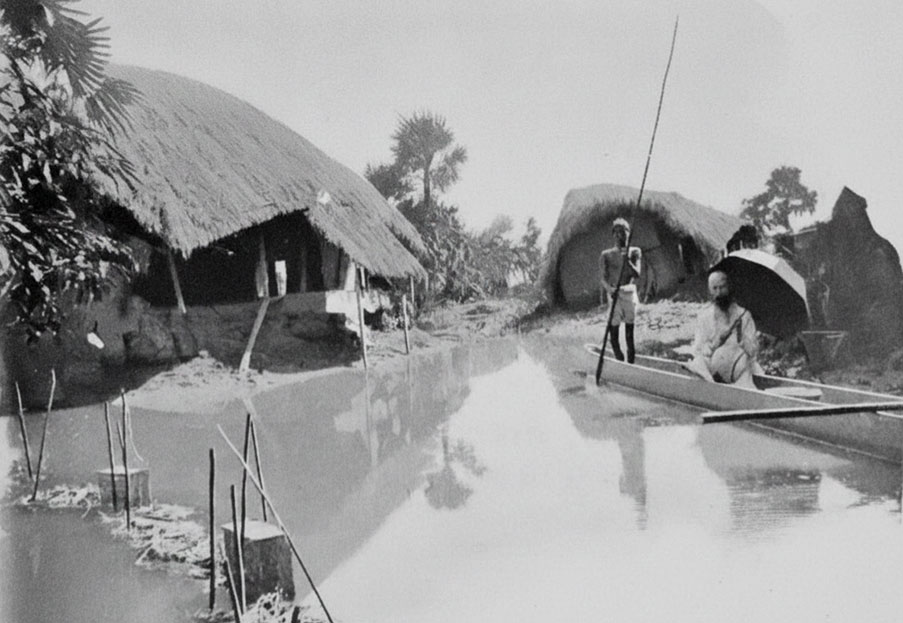
Fr De La Croix, SJ, visiting flood affected villages in Raghabpur in 1901.
The Portuguese Jesuits in Bengal: Foundations and Martyrdom (1576–1650, 75 years)
The initial welcome and favours granted to Fr Fernandes, Fr de Souza and their successors by the local rulers were short-lived. Fernandes was accused of supporting the Portuguese governor and his soldiers during the ensuing conflicts between the Arakanese and the Portuguese in the earlyseventeenth century. He was imprisoned, tortured and left to die by the Arakan king at Dianga on 14 November 1602, becoming the first martyr for the faith in Bengal.
St. Paul’s College at Hugli continued to operate until 1650, run by Portuguese Jesuits who came to serve in Bengal over successive years. The siege of the Portuguese settlement and Bandel Church by Kasim Khan in 1632 forced the college to close for a time. Several Jesuits were killed in the fighting, along with many Augustinian friars and Portuguese settlers. By 1650, the few Portuguese Jesuits still in Bengal had all died, many weakened by the climate.
The French Jesuits in Bengal: Revival and Withdrawal (1690–1740, 50 years)
In 1691, French Jesuits settled in Chandernagore, the only French settlement in Bengal, and were able to revive St. Paul’s College at Hugli. Their efforts, however, did not last. In 1713, the Jesuit Bishop of Mylapore, Mgr Francis Laynes, was visiting churches in Bengal when the Augustinians demanded the dismissal of the French Jesuits. The bishop refused and responded to threats of violence by placing Bandel Church under interdict. Three months later, Bishop Laynes died under suspicious circumstances.
Within the next few years, Hugli College was closed, and in 1740 the Jesuits withdrew from Bengal for the second time. Fr Huetlin (1733–1738) and Fr George Deistermann (1738–1740), both Malabar Province, were the last Jesuits to serve at St. Paul’s College at Hugli.

The English and Irish Jesuits in Bengal: Education and Abrupt Departure (1834–1846, 12 years)
The Jesuits of the Restored Society returned to Bengal for the third time in 1834. The Superior General, Fr Jan Philipp Roothaan, entrusted the Bengal mission to the English Province of the Society. On 8 October 1834, Dr Robert St Leger, formerly Jesuit Vice-Provincial of Ireland, arrived in Calcutta with six other Jesuits. Calcutta was then the capital of British India. Their mission was twofold: to serve the pastoral needs of the Catholic community and to provide education for Catholic children and those from other communities.
On 1 June 1835, the English Jesuits opened St. Xavier’s College on Portuguese Church Street, with Fr Francis Chadwick as its first Rector. Fr Sumner and Br Sinnott were also on the staff, along with two lay teachers. The English Jesuit mission in Bengal ended abruptly in 1846 because of administrative difficulties within the Church. About twenty-five Jesuits returned to England in August 1846, just twelve years after their arrival in Bengal.
Bengal Mission Under the Belgian Jesuits (1859-2026: 166 years)
Thirteen years after the English Jesuits had left Calcutta, the Bengal Jesuit Mission, operating within the Vicariate Apostolic of Bengal, as well as St Xavier’s College, found new life with the arrival of seven Belgian Jesuits led by Fr Henri Depelchin on 28 November 1859. They immediately took up pastoral care of the Catholic community and reopened St Xavier’s College on 16 January 1860.
The Bengal Jesuit Mission, revived and re-established by the Belgian Jesuits 166 years ago, has since grown into seven provinces: Calcutta, Ranchi, Hazaribag, Jamshedpur, Dumka–Raiganj, Darjeeling and Madhya Pradesh.Today, more than 1,500 Jesuits serve across these provinces, accompanying Catholic communities and engaging in pastoral, educational and social ministries among people of many faiths.
